Solution · Refinery & hydrocarbons
Gas Oil & Hydrocarbon Filtration in Refineries at High Temperature
Gas oil pooled from several upstream refinery units carries particles, catalyst fines, scale and corrosion products. At operating temperatures of 80 °C and more, standard polypropylene media reach their limit. A high-flow stage with temperature-rated glass-fiber media retains these solids in a single large-format element — protecting exchangers, pumps, control valves and downstream units.
Where in the process
The filter stage sits in the hot hydrocarbon line between upstream processing (e.g. distillation, cracking or blending) and sensitive downstream equipment such as heat exchangers, feed pumps, burners or product tanks. Its job is the removal of particles and suspended solids — not the separation of dissolved components, water or sulfur compounds, which are handled by other process steps.
What goes wrong without adequate filtration
- Particles, catalyst fines and corrosion products foul heat exchangers and reduce heat transfer
- Abrasive solids wear pump seals, control valves and burner nozzles
- At 80–120 °C, standard polypropylene media soften and lose their structural integrity
- Higher viscosity raises the pressure drop — under-sized filter banks need frequent change-outs in a hazardous area
How it works
- 1
Select media for temperature
Glass-fiber media retain their structure at elevated temperature where polypropylene would deform.
- 2
Size for viscosity
Element count and length are matched to flow and viscosity so the clean pressure drop stays low.
- 3
Retain particles and solids
The pleated element holds particles, fines and scale from the hydrocarbon stream across a large surface.
- 4
Change on ΔP
The operator changes out at a defined differential pressure — in the reference project at approx. 180 kPa.
Typical filtration requirements
- Media and gaskets rated for the continuous operating temperature with a safety margin to the design temperature
- Large filtration area to handle viscous fluid at low differential pressure
- Reliable sealing in existing high-flow housings without modification
- Change-out driven by differential pressure to minimise interventions on the hot line
Why high-flow wins here
Selection & sizing factors
Sizing & selection
Reference project (North America): gas oil at approx. 8 cP, 80–95 °C operating temperature (design 121 °C) and 700–800 kPa operating pressure. Supplied: 320 compatible 60" Pall Ultipleat replacement elements with glass-fiber media, Buna-N gasket, recommended flow rate 50 m³/h per element and a maximum temperature rating of 250 °C. The operator changes out at approx. 180 kPa differential. Send us medium, temperature, viscosity, flow and your housing type — we recommend media, rating and element count.
Real project references
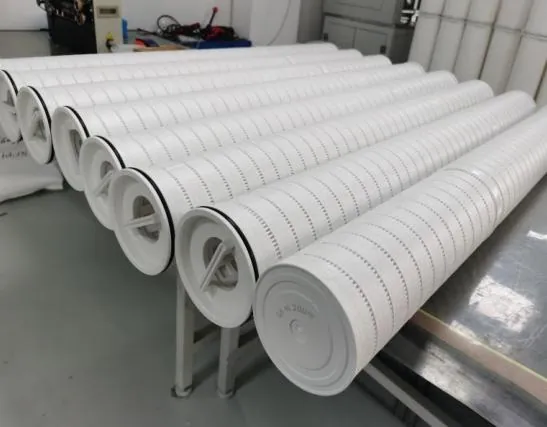
R+F supplies compatible replacement elements and housings. Brand names only identify the original part being replaced.
The right housing for this solution
Hot hydrocarbon service needs a pressure-rated housing with suitable material, gaskets and connections. We supply compatible replacement elements for existing high-flow housings and — where a new vessel is required — configured or custom-built housings, shipped worldwide. Use the housing configurator or request a custom design.
Operational impact
Relevant industries
Related solutions
Inline on the process stream — product filtration, catalyst/resin protection, or intermediate clean-up. It removes particulate from the fluid; media are selected for chemical compatibility.
View solutionImmediately upstream of the equipment being protected. It is a guard/prefiltration barrier targeting particulate that would abrade, plug or foul the downstream asset.
View solutionPlaced wherever clean particulate-free water enters or moves through the process — intake polishing, make-up water, or protection ahead of sensitive equipment.
View solutionFrequently asked questions
Which filter media is suitable for gas oil at 80–120 °C?
Glass-fiber media. In our refinery reference, glass-fiber 60" elements with Buna-N gaskets and a maximum rating of 250 °C run at 80–95 °C (design 121 °C).
Does the filter remove sulfur, water or dissolved components from gas oil?
No. A high-flow element retains particles and suspended solids. Dissolved components, sulfur or water are handled by other process steps.
When should the elements be changed?
At a defined differential pressure. In the reference project, the operator changes out at approx. 180 kPa differential at an operating pressure of 700–800 kPa.
Do the replacement elements fit existing Pall Ultipleat housings?
Yes — we supply compatible replacement elements that drop into existing housings without modification. R+F is an independent supplier of compatible replacements, not the original manufacturer.
The right solution for your process?
Tell us your flow rate, medium and target rating — we recommend the element and, if required, the matching housing.