Solution · Power generation
Power Plant Water Filtration
Power plants move large volumes of water: make-up water for the water-steam cycle, cooling water and service water. Particles, corrosion products and suspended solids in these streams foul exchangers, block nozzles and load downstream treatment such as RO or ion exchange. High-flow elements filter these volumes with few housings and long change-out intervals.
Where in the process
Typical positions are raw and make-up water ahead of demineralisation or RO, side-stream filtration of cooling water and service water for pumps, seals and spray systems. The stage removes particles and suspended solids — it does not remove dissolved salts, hardness or silica; that is the job of the water treatment plant.
What goes wrong without adequate filtration
- Particles and corrosion products foul condensers and plate heat exchangers
- Suspended solids shorten the service life of RO membranes and ion exchange resins downstream
- Small cartridge banks need frequent change-outs during operation
- Unplanned outages are expensive — filtration must run reliably between revisions
How it works
- 1
Define the rating
The micron rating follows the downstream equipment — e.g. 15 µm absolute in the reference project.
- 2
Large area per element
A 40" pleated element with 12 m² filtration area keeps the pressure drop low at high flow.
- 3
Retain particles
Particles, scale and suspended solids are held in the pleated media.
- 4
Change on ΔP
Change-out is triggered by differential pressure and can be scheduled for maintenance windows.
Typical filtration requirements
- Defined, reproducible particle retention (absolute rating where specified)
- High flow per housing with low differential pressure
- Long service life to align change-outs with maintenance windows
- Drop-in compatibility with existing housings
Why high-flow wins here
Selection & sizing factors
Sizing & selection
Reference project (Central Europe): power plant water, existing housings for 3M type HF740B elements. Supplied: compatible 3M HF740B replacement elements, 40" polypropylene, 15 µm absolute, 12 m² filtration area, Buna-N gasket, FDA-compliant materials, max. 80 °C, recommended change-out at 2.1–2.4 bar differential. Tell us water stream, flow, target rating and housing type.
Real project references
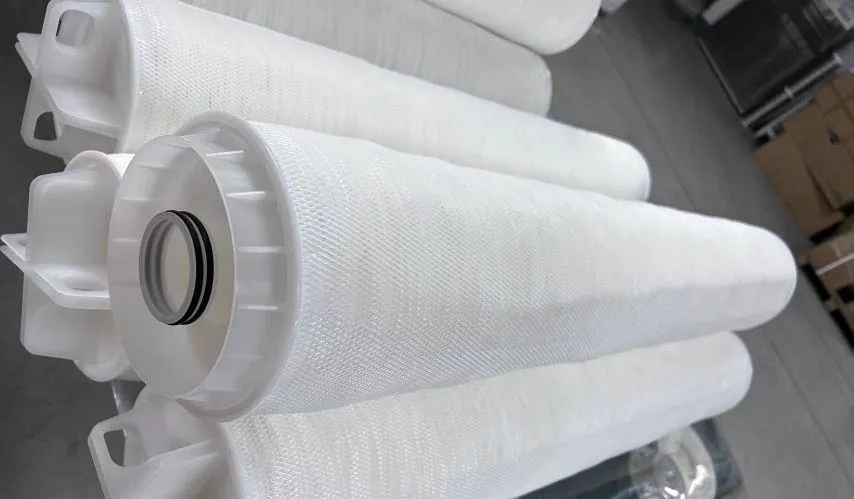
Central Europe · Power plant water
3M HF740B replacement: 40" PP element, 15 µm, for power plant water
- Material
- PP
- Length
- 40 inch
- Absolute rating
- 15 µm
- Filtration area
- 12 m²
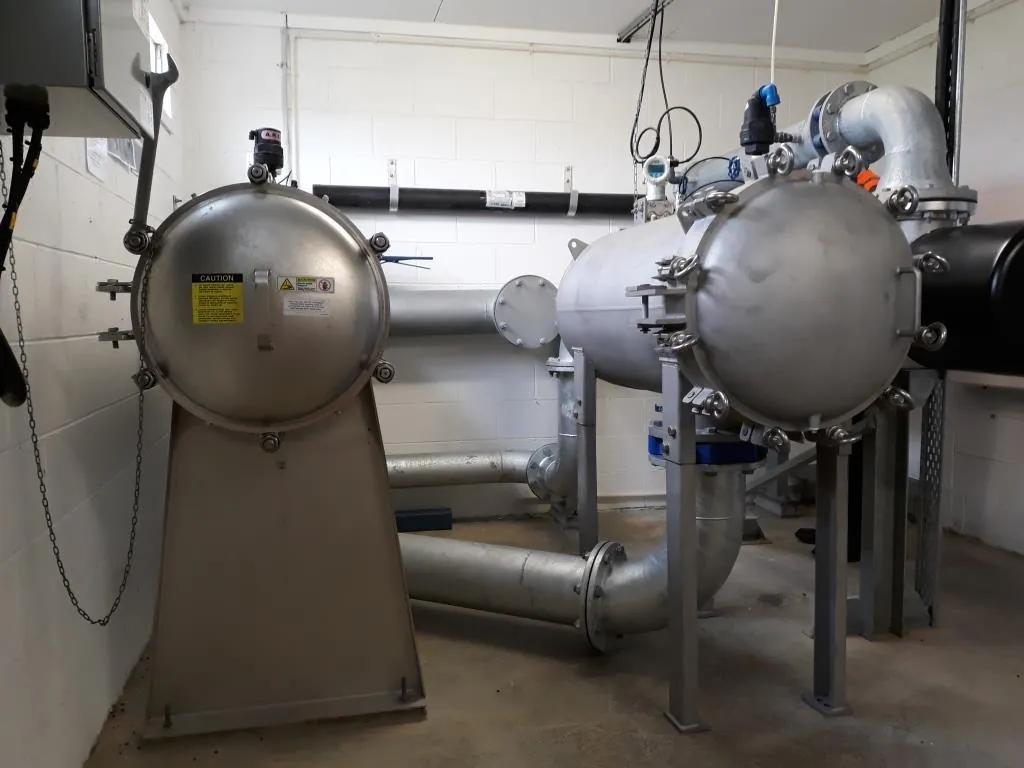
Europe · Raw water (water treatment)
Stainless steel high-flow housing 5 × 40" for 150 m³/h water treatment
- Material
- 304 stainless steel
- Configuration
- 5 × 40" high-flow cartridges
- Design pressure
- 10 bar
- Connection
- DN100 Table E flanges
R+F supplies compatible replacement elements and housings. Brand names only identify the original part being replaced.
The right housing for this solution
Power plants usually run stainless high-flow housings sized to the water stream. We supply compatible replacement elements for existing housings and configured or custom-built stainless housings — shipped worldwide. Use the housing configurator for a new or additional filter stage.
Operational impact
Relevant industries
Related solutions
On the feedwater line and on condensate return, upstream of the boiler / deaerator. It removes particulate corrosion products; it is not a demineralisation stage.
View solutionInstalled as a side-stream loop on the cooling circuit (open tower or closed loop), continuously filtering a slipstream of the circulating water. It targets particulate; it is not a chemical-treatment substitute.
View solutionThis stage sits between the pretreatment (media filters, softening, dosing) and the RO high-pressure pumps — the last mechanical barrier before the membranes. Its job is particulate removal, not the removal of dissolved salts, which the membrane itself handles.
View solutionFrequently asked questions
Is there a compatible replacement for 3M HF740B in power plants?
Yes. In our Central European reference we supplied compatible 3M HF740B replacement elements: 40" PP, 15 µm absolute, 12 m², Buna-N gasket — drop-in for the existing housing. R+F is an independent supplier of compatible replacements, not the original manufacturer.
Does the filter remove hardness or silica?
No. High-flow elements retain particles and suspended solids. Dissolved salts, hardness and silica are removed by the water treatment plant (e.g. RO or ion exchange).
Which rating for power plant water?
It depends on the stream and the protected equipment. The reference project uses 15 µm absolute. Send us your data and we recommend a rating.
When should the elements be changed?
Based on differential pressure — recommended at 2.1–2.4 bar for the reference elements.
The right solution for your process?
Tell us your flow rate, medium and target rating — we recommend the element and, if required, the matching housing.